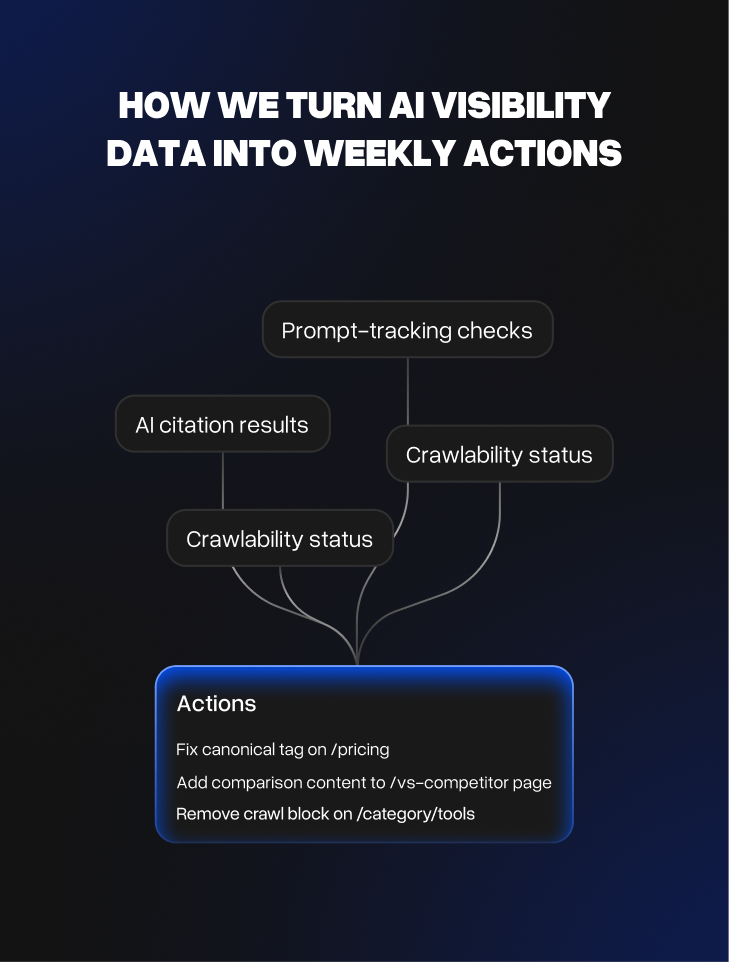
Here's how each step works, and why most teams never get this far.
In our previous piece, we covered the free stack we use to track AI search visibility for Webflow sites: Bing Webmaster Tools, Google Search Console, and OneGlance. That piece is about building the visibility layer. Most teams install the tracking tools, check a few prompts, look at Search Console, even notice where AI is mentioning them or missing them. But after that, the data just sits there.
Step 1: Start With Pages That Can Actually Move the Business
Not every page deserves attention.
A lot of SEO and AEO work fails because teams spread effort across too many URLs at once. They spend time on pages that have little business value, no search demand, or no realistic path to visibility.
We start by looking for pages that already matter:
- Revenue pages
- Pages already getting impressions
- Pages ranking in positions 4 to 20
- Pages getting some AI citations but not enough
- Pages tied to important services, categories, or comparisons
The 4 to 20 range is particularly interesting. Pages ranking in that window are often already appearing in AI Overviews, just without being the cited source. That is a different problem from not ranking at all, and it requires a different fix.
That gap matters. Pages already in the conversation, just not quite winning it, tend to respond well to targeted content changes.
If a page has no search demand and no strategic value, it usually should not be the first thing you optimize.
Step 2: Check Whether the Page Is Even Eligible
Before touching content, we confirm the basics.
If a page is not indexed, blocked, or technically unclear, no amount of content tuning will help. AI systems that rely on search infrastructure can only work with content that search engines can access and understand.
At a minimum, we verify:
- The page is indexed
- The page is crawlable
- The canonical is correct
- The sitemap is clean
- There are no unnecessary crawl blocks

This sounds basic, but it is still the first gate. If search engines cannot reliably see the page, AI discovery becomes a side issue.
Step 3: Find Out What Google Already Thinks the Page Is About
This is one of the most useful steps in the entire process.
Many teams decide what a page should rank for before they check what Google already associates with it. That often leads to conflict.
A page might be written as a comparison page, but Google may mostly understand it as a how-to page. A service page may get interpreted as a blog post. A brand page may be showing up for generic category terms instead of branded queries.
Google Search Console is useful here because it reveals the queries a page is already surfacing for. In the Queries report, use the regex filter (\w+\s){3,}\w+ to surface long-tail queries of four words or more. These are the conversational queries AI systems are built to answer, and they reveal how Google is actually interpreting the page.

That tells you something important: what you intended the page to be is not always what the search engine currently believes it is.
When there is a mismatch, you have three choices:
- Adjust the page so it better matches the current understanding
- Wait and reinforce the intended direction through supporting content
- Create a separate page for the new intent
What you should not do is keep adding formatting tricks and hope the intent changes on its own.
Step 4: Compare the Page Against the Pages That Are Winning
Once we know what the page is and what Google thinks it is, we compare it against the pages that are already being surfaced.
That includes:
- Ranking competitors
- AI Overview sources
- Pages that ChatGPT or Copilot appear to rely on
- Pages that own the same topic more clearly
Across client work we have done, when a client page is not being cited, the sources that tend to show up instead follow a pattern. Official product pages have a structural advantage for queries about their own products. Video content, especially structured tutorials, regularly appears for software and how-to queries. Community content like Reddit appears for opinion and comparison queries.

The goal of this comparison is not to copy the winning pages.
The goal is to understand the gap.
Usually the gap is one of four things:
- They explain the topic more clearly
- They cover more of the topic
- They have stronger internal consistency
- They have more topical authority around the subject
This is where many teams make the wrong conclusion. They assume AI visibility is about answer formatting, FAQ blocks, or placing the summary in the first paragraph. Sometimes that helps. But it does not solve a weak content foundation.
Step 5: Identify the Real Bottleneck
When a page is not performing, the problem is rarely one thing.
It may be:
- Indexing
- Intent mismatch
- Thin topical coverage
- Strong competition
- Poor internal linking
- Weak page purpose
- Lack of supporting pages
- A page that should not exist as a standalone URL
One thing that reframes this well: for informational queries four words or longer, AI Overviews appear on almost everything. The question is almost never whether an AI Overview will show up. It is whether your page is the one being cited when it does.
That shifts the diagnosis. If you are not being cited, the issue is not that AI Overviews do not exist for your query. The issue is something specific about how your page is understood relative to the pages that are being cited.
This is why the analysis step matters. If you do not understand the bottleneck, you will choose the wrong action.
- A page with strong search demand but weak coverage should probably be expanded
- A page ranking for the wrong intent may need to be rewritten
- A homepage being forced to carry too many unrelated terms may need dedicated service pages
- A topic that is too competitive may need a cluster, not a single post
The best optimization decision depends on the specific constraint.
Step 6: Choose One Action, Not Ten
This is the part most teams skip.
Once the diagnosis is clear, the next step is to choose a single primary action. Usually that action is one of these:
- Rewrite
- Expand
- Split into separate pages
- Merge overlapping pages
- Build supporting content
- Strengthen internal links
- Create a dedicated service page
- Wait and monitor
The mistake most teams make is trying to do all of them at once. That creates noise. It becomes impossible to know what actually helped.
A much better approach is to change one major thing, then observe the effect.
- If the page is already indexed and the intent is mostly right, a rewrite may be enough
- If the topic is broad and fragmented, the answer may be a cluster
- If the homepage is trying to rank for too many intents, the answer may be a new page
- If the page is already close and only needs more clarity, more content is not always the right move
Step 7: Measure the Outcome
Every action should feed back into measurement.
We look at:
- Impressions
- Clicks
- Rankings
- Long-tail query growth
- AI citations
- Branded vs non-branded visibility
- Whether the page is being interpreted more accurately
The most important thing is not whether the page changed. It is whether the right signals changed.
For example: did the target queries improve? Did the page start appearing for the intended intent? Did AI systems begin citing the correct section? Did long-tail visibility grow?
If the answer is no, the next action may need to be different. That is why this is a loop, not a one-time checklist.
What We Learned From Running This Process
After running these experiments across multiple Webflow clients, a few things became clear.
SEO fundamentals still matter. If search engines cannot index the page properly, AI systems usually cannot use it reliably either. We check this first every time.
Intent alignment matters more than formatting. The strongest results come from making the page clearly about the thing you want it to be about. Pages built tightly around a specific comparison or how-to query tend to get cited more consistently than pages that cover a broader topic without leading with a direct answer.
Competition still decides a lot. Some topics are crowded. Others have room for a newer site to win quickly if the topic is clear and the content is specific. Knowing which situation you are in changes the action.
Content clusters are usually stronger than isolated pages. AI systems and search engines both benefit from clear topical relationships. A single page on a competitive topic almost always underperforms compared to a cluster of pages that reinforce each other.
And many of the common AEO hacks matter less than people think. Schema, FAQs, tables, and answer-first formatting can help presentation, but they do not compensate for weak content strategy.
The Simplest Version of the Workflow
Find a page with opportunity. Check whether it is technically eligible. Learn what Google already thinks it is about. Compare it with the pages that are winning. Identify the real bottleneck. Choose one action. Measure the result. Repeat.
That is the part most teams are missing. Not more data. Not more hacks. A better decision loop.
AI search is changing how users discover information, but the way to improve visibility is still surprisingly human: understand the problem, choose the right action, and measure whether it worked.
That is what turns AI visibility data into actual growth.
At Neue World, we run this process as a dedicated service for Webflow teams. If you want to know where your site stands and which pages are worth acting on first: AI Search Optimization
