.png)
Most Webflow teams know their Google rankings and traffic numbers, but have no visibility into whether ChatGPT is mentioning them, how they're being described, or why a competitor appears instead when a buyer asks or Google serves an AI Overview.
Without that visibility, they can't fix inaccurate information, identify content gaps, measure the impact of changes, or improve their presence across AI search. They're effectively optimizing blind.
How Do You Track AI Visibility Using Bing Webmaster Tools?
Bing powers Microsoft Copilot. When Copilot surfaces a recommendation, it's drawing from Bing's index. That makes Bing Webmaster Tools one of the few places you can see direct feedback from an AI system on your content, for free.
It's one of the most reliable sources because it comes directly from the search engine logs, not a third party. Under its AI Performance, it gives the Important AI metrics like the number of Citations, pages getting citations.
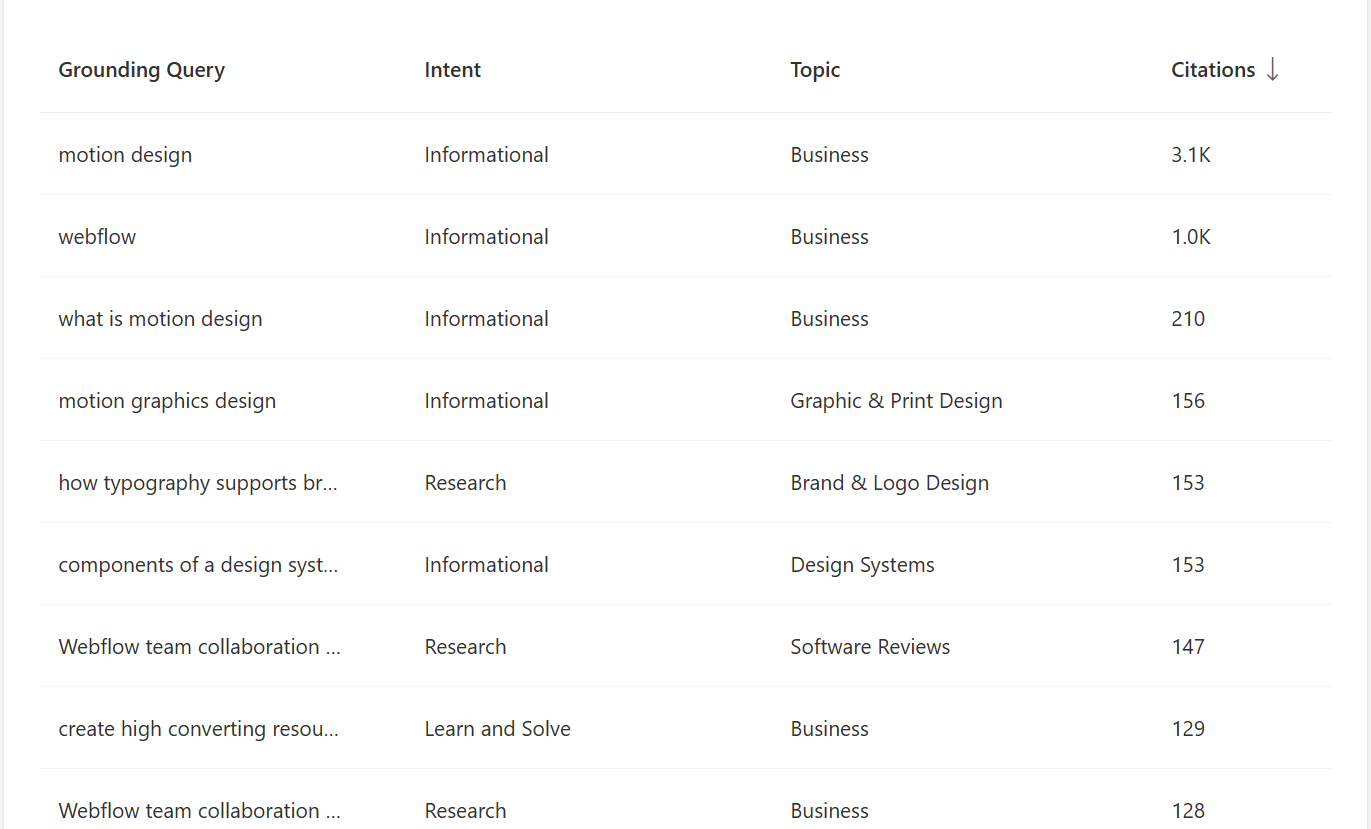
Recently, Bing has also expanded its dashboard to give topical and intent data, which is very useful to build a strategic direction of website into AI visibility.
Submit your sitemap, run URL inspection, and check for crawl blocks as a baseline. If you haven't set it up yet, here's what it covers and why it matters for Webflow sites.
Bing's AI dashboard shows how Copilot is interpreting your pages and which content it's extracting. Here's how to use it and what the citation data tells you.
If Copilot is extracting the wrong section of a page, or missing a core capability entirely, the fix is almost always moving that information higher on the page and making it explicit. AI extracts from the top. If the key statement is buried in paragraph three, it won't surface.
Set up IndexNow. It's a protocol Bing supports that notifies search engines immediately when your content changes rather than waiting for a scheduled crawl. For clients publishing frequently, this means AI systems see updated content faster. Step-by-step setup guide for Webflow.
If Copilot is hedging on a capability your client considers core, that's a content clarity problem. The information is probably on the site but not stated directly enough for AI to extract it confidently. Prioritise that page before any other AEO work.
Google Search Console
It is the official tool from Google to track the search data from their search engine, and recently, it has also launched AI tracking.
How Do Long-Tail Queries Reveal AI Visibility?
AI has changed the user searched patter, and now people do conversions rather than asking question so search engines have started to find content with long tail queries. Tracking them gives a picture of AI visibility. They aren’t default visible at GSC, and because their volume is usually low so have to use GSC filters. Use (\w+\s){3,}\w+ to filter the queries.
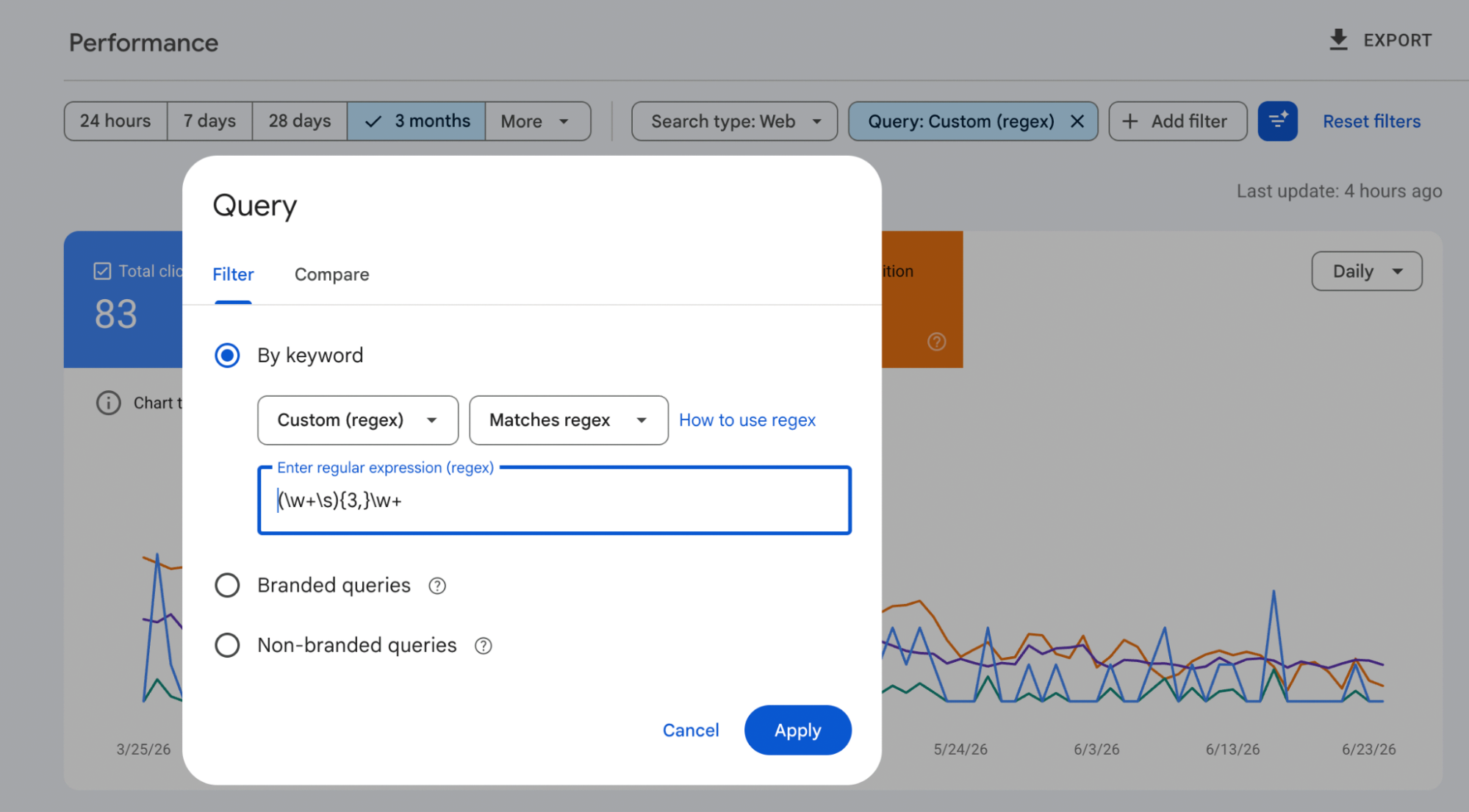
These are the queries where AI Overviews appear most consistently, and where traffic is being absorbed before reaching the site.
Patterns We Consistently Find Across Webflow Clients
- Branded queries are usually healthy. Category, comparison, and problem-based queries are where AI is gaining visibility.
- Pages ranking between positions 4 and 20 are the biggest opportunities. They're already relevant but need stronger signals to be cited by AI.
- Question and conversational queries (how, what, why, which) increasingly drive AI answers and should be monitored separately.
How We Turn That Data Into Action
- Rewrite pages to answer questions immediately. Lead with a direct answer, then expand with supporting context.
- Prioritize pages with many long-tail rankings but few clicks. This usually means AI is answering the query before users reach the page.
- Close topical gaps. If competitors are cited for topics your site doesn't cover, create or expand content around those subjects.
- Measure the impact. Track citations, AI visibility, and long-tail query growth after every update to validate what's working.
What Google Is Doing
AI Overviews now appear on a much wider range of queries than when they launched. Google surfaces them most consistently on informational and comparison queries. Transactional queries still mostly return standard results.
OneGlance
OneGlance tracks how AI platforms are representing a brand in actual user interfaces, across ChatGPT, Gemini, Perplexity, Claude, and Google AI Overview. It uses real browser sessions rather than API queries, which matters because what a user sees in ChatGPT's interface is often different from what the API returns for the same prompt. Citation formatting, source cards, and competitive co-mentions all differ, and OneGlance captures what a buyer actually encounters.
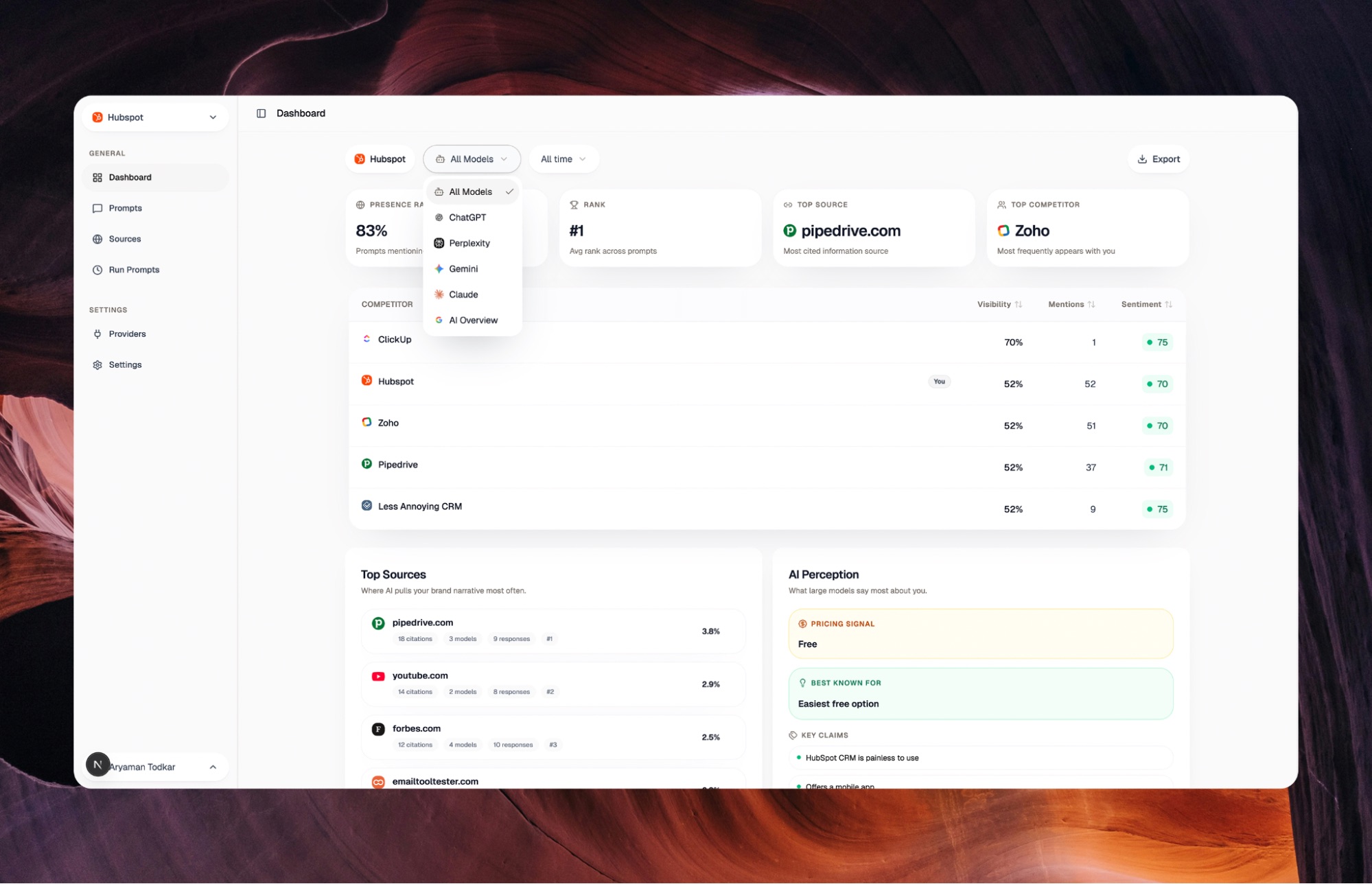
Running it after any major content update confirms whether the changes are being reflected in AI responses. AI systems update their understanding of a brand gradually, so if a key capability was added to a page but OneGlance still shows AI hedging on it, the page likely needs a stronger signal: more explicit statements, consistent language across multiple pages, or better internal linking to reinforce the entity.
It's also worth checking competitor co-mentions. When a buyer asks AI to recommend tools in a category, who shows up alongside you? If a competitor consistently appears and you don't, look at what their content is doing differently. Usually it's a clarity difference, not a volume difference.
If AI is consistently misrepresenting a client's pricing, positioning, or capabilities across multiple platforms, that points to a systemic content problem rather than a single page issue. The fix is making sure every high traffic page states the same things consistently in the same language, since AI builds confidence from repetition and consistency across sources.
It's self-hosted and free. The GitHub repo: github.com/aryamantodkar/oneglanse
How We Handle This for Clients
At Neue World, we run this as a dedicated service. We set up the tracking stack, identify where AI is misrepresenting or underrepresenting a client's product, and implement the content and structural changes that close the gap.
If you want high ai search performance for your brand: AI Search Optimization
