SEO & AEO Services for B2B Companies in Dubai


AI changed where buyers start.
During AI research
During peer validation
During comparison
One program. Two surfaces. →
Search Engine Optimization
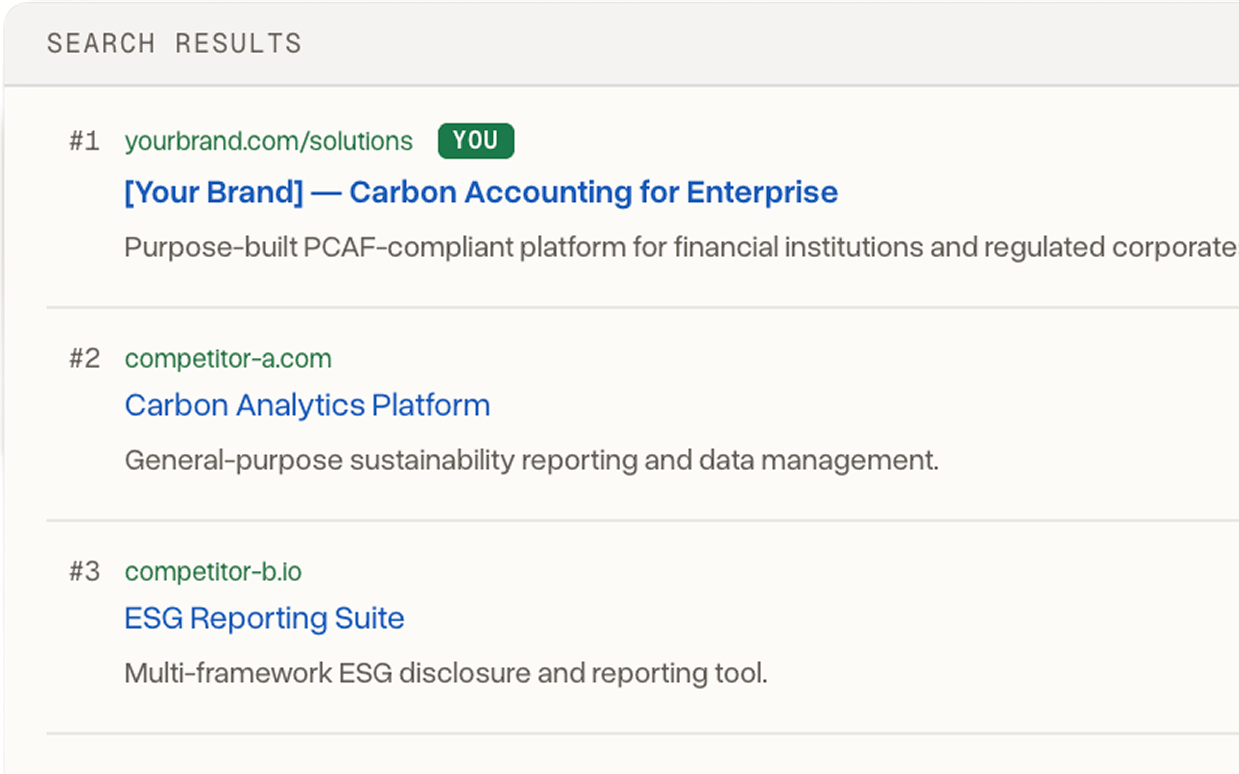
Answer Engine Optimization
![Text from AI answer engine showing a query 'best ESG software for regulated corporates' and part of a response highlighting '[Your Brand]' as increasingly cited for its strength in PCAF and TCFD alignment for regulated enterprises.](https://cdn.prod.website-files.com/699beb6b1c273ecfe3f5525c/6a329ba6ada829e6bf498c4d_image%20499.png)
One program. Four phases. Built to compound.
PHASE 01
Technical issues resolved. Entity clarity established for your brand and products. Buyer intent mapped by profile. Measurement baseline set across search performance, AI visibility, and technical health monitoring.
PHASE 02
Content restructured around genuine buyer research needs. Third-party presence built across directories, partner pages, and publications. AI citation testing run monthly, scored against baseline.
PHASE 03
Regional landing pages. Comparison pages for buyers in evaluation mode. Case studies structured around outcomes. Conversion path from organic search to demo request mapped and tested.
PHASE 04
Highest-performing content expanded into topic clusters. Remaining gaps filled. AI discovery refined at scale. Year 2 roadmap produced at close of engagement.
Results that reflect how enterprise buyers actually make decisions.

How we measure it

Search performance

AI citation scoring

Technical health

Entity visibility
Scope-based retainer. Transparent from the start.
- Full SEO and AEO execution across all four phases
- Up to 10 hours Webflow support per month — no extra cost
- Content briefing, structuring, and evaluation
- Monthly performance reports and strategy iteration
- AI query testing against a growing 100–200 query universe
- Year 2 roadmap at engagement close
Frequently Asked Questions
What kinds of B2B companies is this built for?
The program works best for B2B companies with a longer sales cycle — where buyers research, compare, and validate before ever reaching out. SaaS, professional services, fintech, climate tech, infrastructure. If your buyers are enterprise or mid-market, credibility drives the first interaction, and you're currently invisible in the AI research phase — this is the right fit. If you're selling transactional or high-volume low-value products, paid search will serve you better.
What's the difference between SEO and AEO, and why do I need both?
SEO gets you ranking on Google and Bing. AEO gets you cited by AI platforms — ChatGPT, Perplexity, Google AI Overviews. The difference matters because enterprise buyers increasingly start their research through AI before they ever visit a website. If you only do SEO, you're visible on one surface. If you only do AEO, you have no organic foundation to build on. The two compound each other — which is why we run them as one program.
Is this right for my company if we're already doing SEO?
Yes — and it's more urgent if you are. Most companies doing traditional SEO have a technical foundation Google can read but AI systems can't. The structural signals AI platforms need — entity clarity, schema, structured content, third-party citations — are different from what ranks on Google. We assess where you currently stand and build what's missing on top of what you have.
Why a retainer? Can we start with a shorter engagement?
Organic acquisition compounds — it doesn't spike. The 4-phase structure exists because each phase builds on the last: foundation before discovery, discovery before conversion. A short engagement can fix technical issues but won't produce qualified inbound. If you're looking for a quick win, paid search is the right tool. If you're building a channel that reduces reliance on paid spend month over month, this program is what does that.
Who writes the content — you or us?
You write the body content. We brief it, structure it, and evaluate it before it goes live. This isn't outsourcing your voice — it's making sure what you publish is structured to be cited by AI systems and ranked by search engines. Generic content doesn't get cited regardless of how well the site is built. Your expertise is the signal. Our job is to make it legible to both.
What does the free AI Visibility Report include?
A senior specialist reviews how ChatGPT, Perplexity, and Google AI currently understand and represent your brand — across your three most important query clusters. You get a gap analysis against competitors showing up in those answers, a technical assessment of your current SEO foundation, and a prioritised fix list. Reviewed by a person, not generated by a tool. Delivered within 24 hours.
How is this different from hiring an SEO agency?
Most SEO agencies optimise for Google rankings and stop there. We run both surfaces simultaneously — traditional search and AI answer engines — using Flozi, our own AI visibility measurement platform, to track citation across ChatGPT, Perplexity, and Gemini monthly. You also get Webflow implementation included, which means technical fixes and content changes happen without a separate development engagement.
What results should we expect and when?
Technical fixes and schema improvements typically show movement in AI citation within 4–8 weeks. Meaningful organic search movement takes 3–4 months. Qualified inbound through organic channels starts appearing in Phase 3. Anyone promising results in 2 weeks is selling something else. We set a measurement baseline in Phase 1 so every phase has a defined benchmark to move against.
Do you work with companies outside Dubai?
Yes. The retainer is built for B2B companies where credibility drives the first sale — we work across UAE, UK, and US. Dubai is where we're based. Most of our engagements are remote.