.avif)
We design for climate tech companies. And over the course of that work, across clean energy, carbon management, and sustainability SaaS, we've come to see branding in this space as something more specific than it's usually treated as. It's not a visual identity project. It's a trust architecture.
Every decision (colour, typography, layout, photography, where you place a certification badge, what your CTA says) is shaping whether a buyer believes you before they've spoken to a single person on your team. In a sector where greenwashing has made scepticism the default, that belief is the hardest thing to earn and the easiest thing to lose.
We work with climate tech and clean energy companies at Neue World. Most recently with BEC, a clean energy AI infrastructure company we took from a Canva logo and Mailchimp template to a full brand identity and website. What follows is how we think about design decisions in this space, and why we think each one matters more than it appears to.
.avif)
Your buyer's visual diet matters more than your mission statement
The most common mistake in climate tech branding is designing for the category instead of the buyer.
Here's what that looks like in practice: a carbon management platform targeting CFOs and sustainability directors at Fortune 500 companies launches with a website that uses leaf green, rounded sans-serif type, and stock photography of people planting trees. It looks like a sustainability brand. The problem is, it doesn't look like anything their buyer takes seriously.
A CFO's visual world is Bloomberg, McKinsey reports, enterprise dashboards, and the websites of the software they already pay six figures for. That's their baseline for "this is credible." When your brand looks like an NGO brochure instead of enterprise infrastructure, you've lost them before they've read a single line of copy.
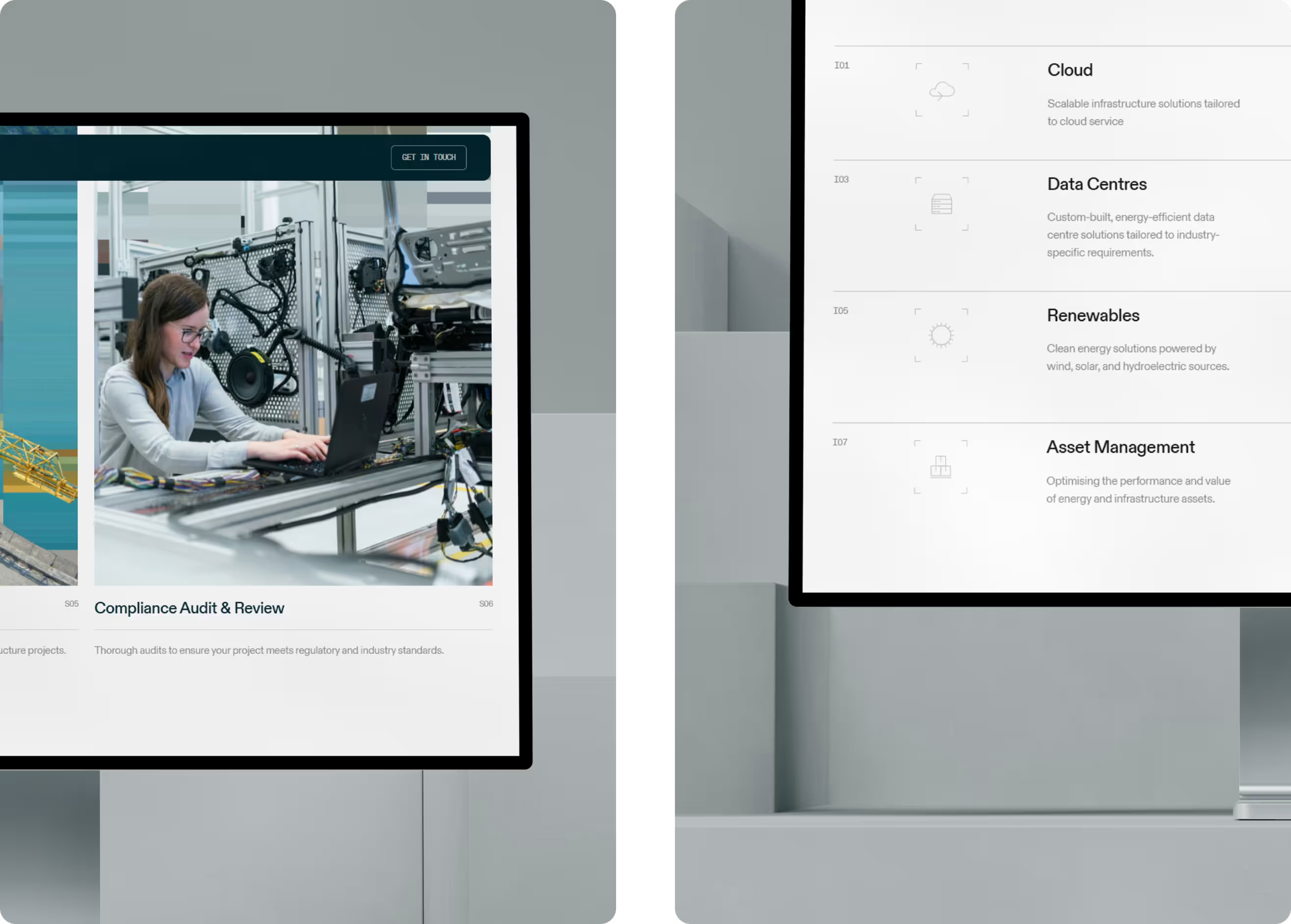
The strategic move is to design for the world your buyer already inhabits, not the world your mission aspires to. That doesn't mean ignoring your environmental purpose. It means encoding it in ways that don't trigger the buyer's skepticism reflex.
When we started the BEC project, their founding team's initial instinct was blue tones, black-and-white contrasts. The safe, corporate route. We pushed them toward something more distinctive: vibrant nature-inspired visuals, a pixel-blur treatment, and a bold brand identity built around the "+" symbol, representing the idea of adding value to existing energy resources. It was ambitious, but it was grounded in a strategic bet: BEC's buyers (hyperscalers, enterprise computing clients) needed to see confidence, not caution. A safe brand would have signaled a safe company. In a sector defined by bold infrastructure bets, that's the wrong message.

They later described choosing that direction as "game-changing." Not because it was prettier, but because it was strategically correct.
Dark backgrounds aren't an aesthetic preference. They're a positioning tool.
Let's talk about something specific: the dark premium aesthetic that's becoming more common in climate tech. Deep blacks, editorial-grade photography, restrained white typography, generous negative space.
This isn't a trend. It's a strategic choice, and it works for a precise reason.
In enterprise SaaS, dark backgrounds have historically been associated with developer tools, fintech, and high-end platforms. Categories where the buyer expects sophistication and technical depth. When a climate tech company adopts this visual language, they're borrowing credibility from adjacent categories. They're saying, without words: we belong in the same conversation as your ERP system, your data platform, your financial infrastructure.
If your customer signs six-figure annual contracts through a formal procurement process, design like the other vendors in that process. If your customer is a sustainability-conscious consumer making a $20/month subscription decision, design like the brands they already love.
Same mission. Completely different visual strategy.
The hero section is a qualifying conversation
Most climate tech homepages try to do too much above the fold. They want to communicate the mission, the technology, the product suite, and the social proof, all before the first scroll.
We think about the hero section differently. It has one job: qualify the visitor.
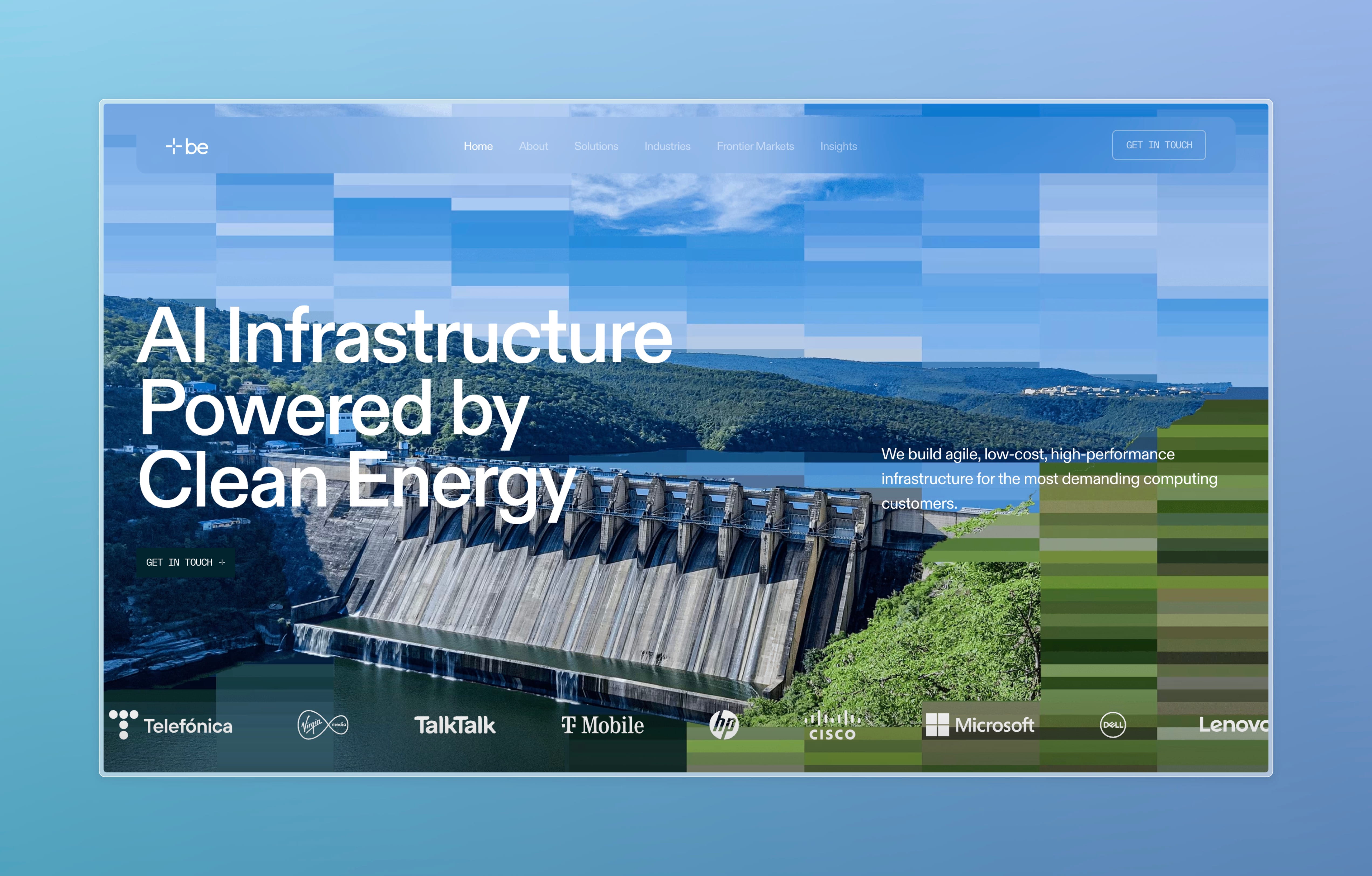
A strong hero answers two questions in under five seconds. First: am I in the right place? Second: is this for someone like me? If the answer to both is yes, the visitor scrolls. If the answer to either is no, they leave. Either outcome is fine. A hero that tries to retain everyone converts no one.
This means the headline needs to be specific enough to attract the right buyer and precise enough to signal your level of sophistication. "Making the world a better place" attracts everyone and qualifies no one. "AI-powered carbon management for enterprise compliance" attracts a narrow audience, and that's exactly the point.
The CTA in the hero matters too, but not for the reason most people think. The choice between "Start free trial," "Book a demo," and "Talk to our experts" isn't a UX decision. It's a signal about where you sit in the market. A free trial says "product-led, try before you buy." A demo booking says "sales-led, we'll walk you through it." "Talk to our experts" says "consultative, we'll understand your problem first." Each one sets a different expectation about the buying experience, and the buyer will hold you to it.
Social proof isn't a section. It's the product.
Here's where climate tech diverges from almost every other SaaS category.
In most B2B software, the logo bar is a nice-to-have. It adds a layer of credibility, maybe tips a hesitant buyer over the edge. But the product demo, the feature comparison, and the pricing page do the heavy lifting.
In climate tech, the trust architecture is inverted. The logo bar, the certifications, the partnerships, the regulatory accreditations: these aren't supporting evidence. For many buyers, they are the product. An ISO 27001 badge, a PCAF accreditation, a partnership with a recognized carbon registry. These aren't decorative. They're answering the buyer's most pressing question: can I stake my compliance on this?
This has direct implications for how you design these sections. Most websites treat credentials as a footnote. Small logos, muted colors, pushed to the bottom of the page. In climate tech, they deserve the same visual weight as your hero section. Give them space. Make the logos legible. Let the certifications breathe. This section is doing more commercial work than your feature list.
We learned this clearly working with BEC. Their clients (hyperscalers, telecom companies, enterprise computing buyers) weren't just evaluating technology. They were evaluating whether BEC was a safe bet. The partnerships section (HP, Cisco, Microsoft, NVIDIA, Dell, IBM, Google Cloud) wasn't an afterthought in our design. It was strategically placed immediately below the hero, because for BEC's buyer, that logo bar was the qualifying information. Everything else was supplementary.
Photography should carry emotion so copy can carry information
There's a persistent temptation in climate tech to make photography do double duty. To find images that are both emotionally resonant and informationally clear. The result is usually neither. You end up with stock photos of solar panels that are technically relevant but emotionally dead, or sweeping landscape shots that look beautiful but don't connect to anything on the page.
The more effective approach is to separate the jobs entirely. Let photography handle the emotional register: scale, ambition, the weight of the problem, the beauty of the solution. Let copy, UI, and data visualization handle the information.
Aerial and geological photography works exceptionally well for this. An overhead shot of a river delta, an ice shelf fracture, a volcanic coastline. These images carry inherent drama and connect to environmental themes without being literal. They don't scream "we're a sustainability company." They create a feeling of consequence and scale that primes the buyer to take the conversation seriously.
The climate tech companies that get photography wrong usually make one of two mistakes. Either they use generic stock (wind turbines, smiling people in hard hats) that's so overused it registers as visual noise, or they use abstract data art that feels disconnected from any human or natural reality. The sweet spot is imagery that feels specific, like it belongs to your brand and no one else's, while still being flexible enough to work across your website, your pitch deck, and your annual report.
Product naming is information architecture in disguise
This one's subtle but powerful, and we find ourselves coming back to it in almost every climate tech project: the way you name and organize your products tells the buyer how seriously to take your ecosystem.
A company with one product called "Carbon Tracker" reads as a tool. A company with a named platform, a marketplace, an AI engine, and an API reads as infrastructure. Both might do similar things under the hood. But the buyer's willingness to pay, and their confidence in your longevity, is dramatically different.
The strategic consideration here is what linguists call lexical framing. When you give your products distinct, branded names (rather than descriptive labels), you're implicitly claiming that each one is substantial enough to warrant its own identity. When those names follow a consistent architecture (a shared prefix, a thematic family, a clear hierarchy) you're signaling that you've thought about how the pieces fit together. And in a sector where buyers are wary of point solutions that won't scale, that signal matters.
The naming also shapes your landing page in practical ways. If you have three products serving three different personas, your page needs to let visitors self-select quickly. This means clear visual segmentation, intuitive navigation, and a product overview that communicates the ecosystem before asking the visitor to drill into any single component. The worst version of this is a long page that explains Product A in full, then Product B in full, then Product C in full. By which point the visitor who only needed Product B has already bounced.
Regional context isn't a localization exercise. It's a trust signal.
For climate tech companies operating in specific regions (the Middle East, South Asia, Africa, Southeast Asia) there's a design dimension that most Western-focused agencies miss entirely.
In these markets, demonstrating local understanding isn't just about translating your UI into Arabic or Hindi. It's about signaling that you understand the regulatory landscape, the business culture, and the specific sustainability challenges of the region. A bilingual interface isn't a feature. It's a credential. A partnership with a regional Chamber of Commerce isn't a press release. It's proof that you've done the work of embedding yourself in the local ecosystem.
The design challenge is threading the needle between two failure modes. The first is looking like a generic Western SaaS product that's been localized as an afterthought. Same layout, same imagery, same value props, just translated. Buyers in the MENAP region or Southeast Asia can spot this immediately, and it signals that their market is secondary to yours. The second failure mode is over-indexing on regional specificity to the point where global investors and partners don't see a scalable business. The brand feels local rather than global-with-local-depth.
The solution, in our experience, is designing a brand that's architecturally global but textured with regional credibility. The visual system, the typography, the layout patterns: these should feel internationally competitive. But the content strategy, the partnership signals, the regulatory references, and the language choices should make it unmistakable that this company belongs to its market in a way that a competitor parachuting in from San Francisco never could.
The real question behind every design decision
If there's a single thread through everything we've laid out here, it's this: in climate tech, design is not a creative exercise. It's a strategic one.
Every choice (the color palette, the hero copy, the placement of your certifications, the photography style, the product names, the regional signals) is either building trust or eroding it. There's no neutral. There's no "it's just an aesthetic preference." Your buyer is walking onto your website carrying a decade of greenwashing skepticism, regulatory anxiety, and procurement caution. Every pixel either reassures them or gives them a reason to leave.
The companies that win in this space aren't necessarily the ones with the best technology. They're the ones whose brand makes the technology believable. And that's not something you achieve by picking the right shade of green. You achieve it by understanding, at a strategic level, what your buyer needs to see, feel, and verify before they'll trust you with their climate data, their compliance obligations, and their board's scrutiny.
That's the work we do at Neue World. Not making things look good, but making design decisions that earn trust in categories where trust is the hardest currency there is.
If you're building a climate tech company and your brand isn't pulling its strategic weight, we should talk.
See our work with BEC →
