In January 2025 we published a list of the tools we use to run a remote design agency. ClickUp was on it. We don’t use it anymore, and we don’t use anything like it.
What we use instead is called VIA. We built it in-house, it runs on our own subdomain, and over the past several months it has quietly become the place the agency actually operates from. This is what it does, why we built it, and what we got wrong on the way.
Why would an agency build its own project management tool?
Because the tools available were either priced for companies much larger than us, or built for workflows we don’t have.
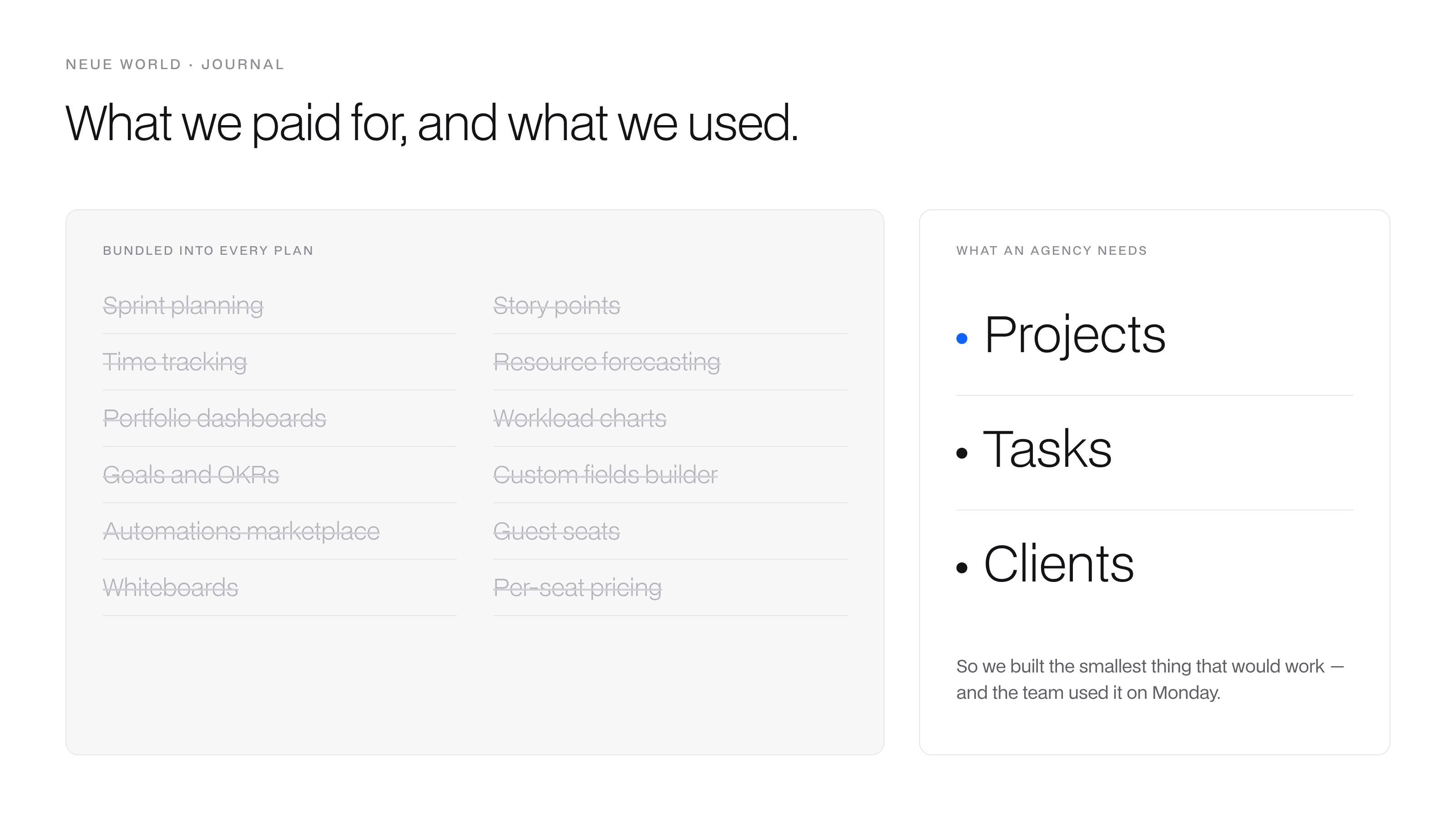
Every project management platform we tried came with the same tradeoff. The affordable ones were too rigid. The flexible ones were expensive per seat, and most of what we were paying for was functionality we would never touch. Sprint planning, time tracking, resource forecasting, portfolio dashboards. A design agency running a handful of concurrent client projects does not need most of that, but you pay for it anyway because it’s bundled.
So we built the smallest thing that would work. Projects, tasks, clients. Nothing else. A weekend of work in Claude Code and we had something our team could use on Monday.
That was the whole intention. It wasn’t a product plan.
What does VIA actually do now?
It holds everything the agency knows and makes it queryable.
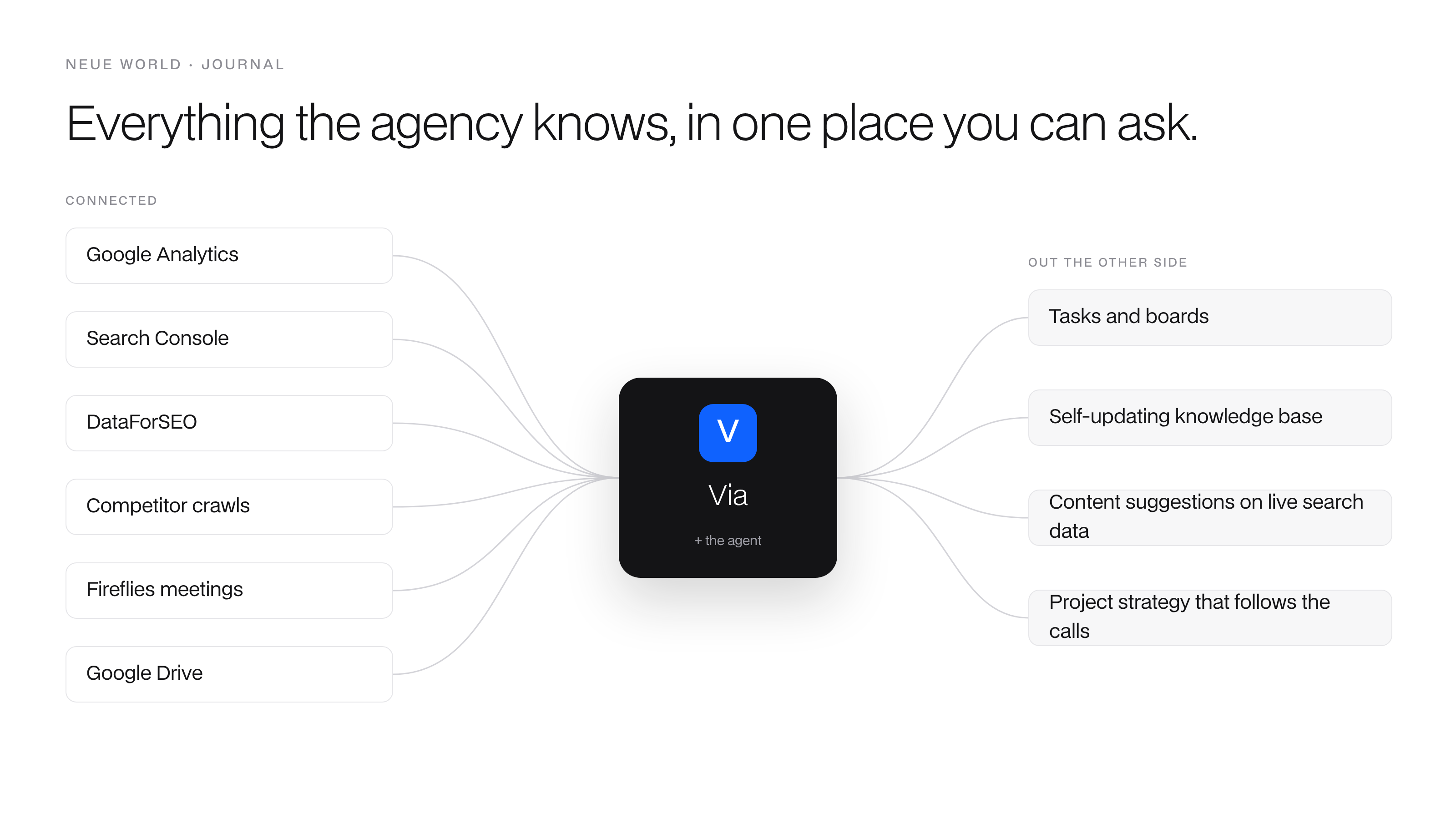
The task management is still there and still deliberately simple. But around it we’ve connected the systems that were previously living in separate tabs and separate logins.
On the search and performance side, VIA pulls from Google Analytics, Google Search Console, Bing Webmaster Tools, and DataForSEO. Crawlers monitor our own pages and our competitors’ pages on a schedule. Content suggestions surface against live search data rather than against a spreadsheet someone updated last quarter.
On the knowledge side, there’s a knowledge base that updates itself. This matters more than it sounds. Agencies change strategy constantly — you learn something from a client engagement, an approach stops working, you pivot a service line. Most internal documentation captures a decision and then slowly becomes a record of what you used to think. Ours rewrites as the strategy moves, so when we query it, we get what we believe now.
And on the client side, we connected Fireflies, our meeting transcription tool. Client calls get transcribed, filed automatically into the correct project, and the project strategy updates against what was actually discussed. Nobody writes the notes up afterwards. Nobody forgets to.
What is the VIA agent?
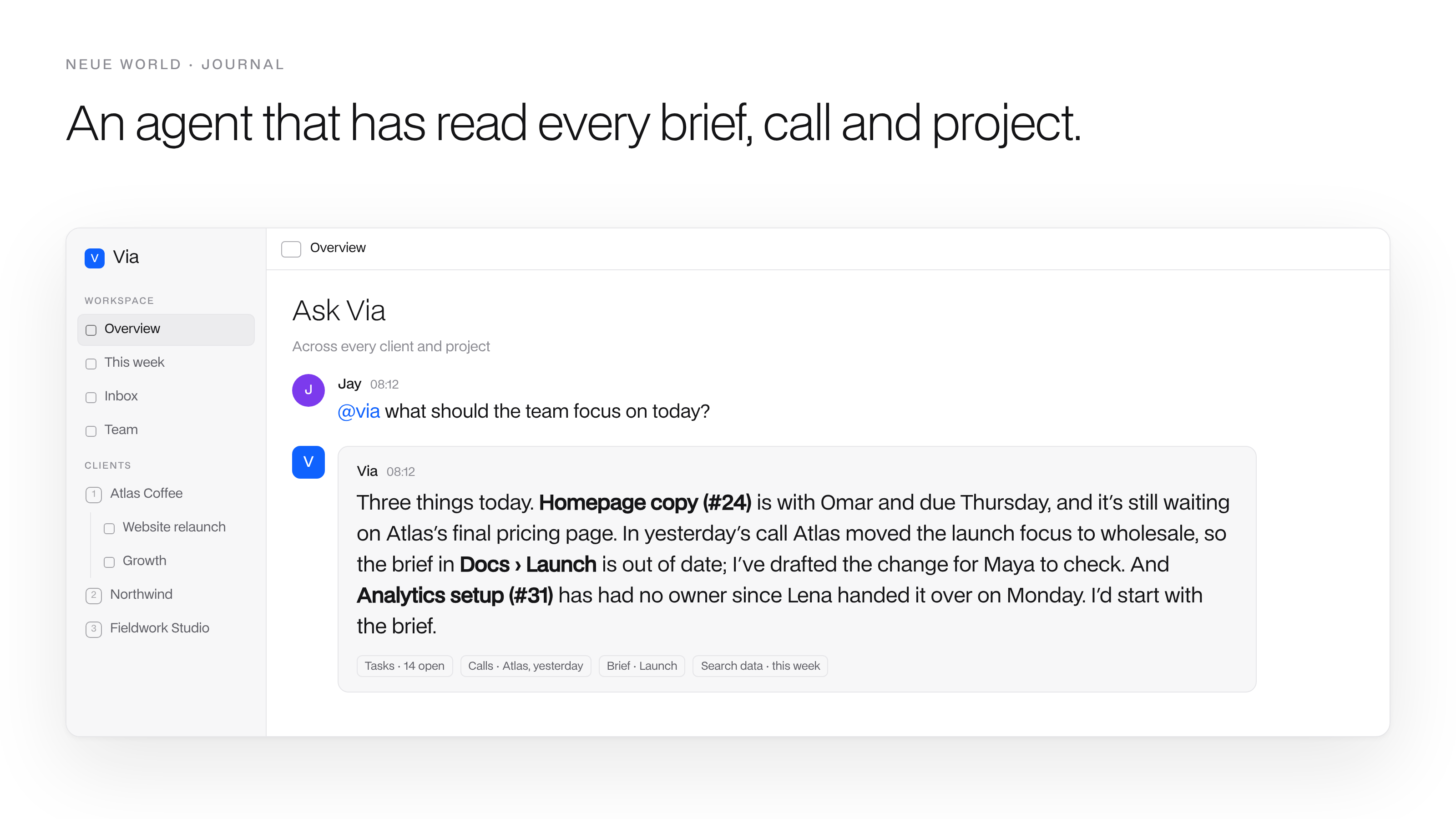
It’s an agent built on the Anthropic API that has read every brief, every client meeting, and every project in the system.
This is the part that changed how I work rather than just where I click.
I can ask it what the team should focus on today. What’s at risk this week. What moved yesterday. It answers from the actual state of the agency — the open tasks, the recent calls, the strategy documents, the performance data — not from a dashboard I then have to interpret myself.
The distinction matters. A dashboard shows you numbers and leaves the synthesis to you. An agent with full context does the synthesis and shows you the reasoning. For someone running multiple projects across multiple companies, that difference compounds daily.
What made this possible that wasn’t possible before?
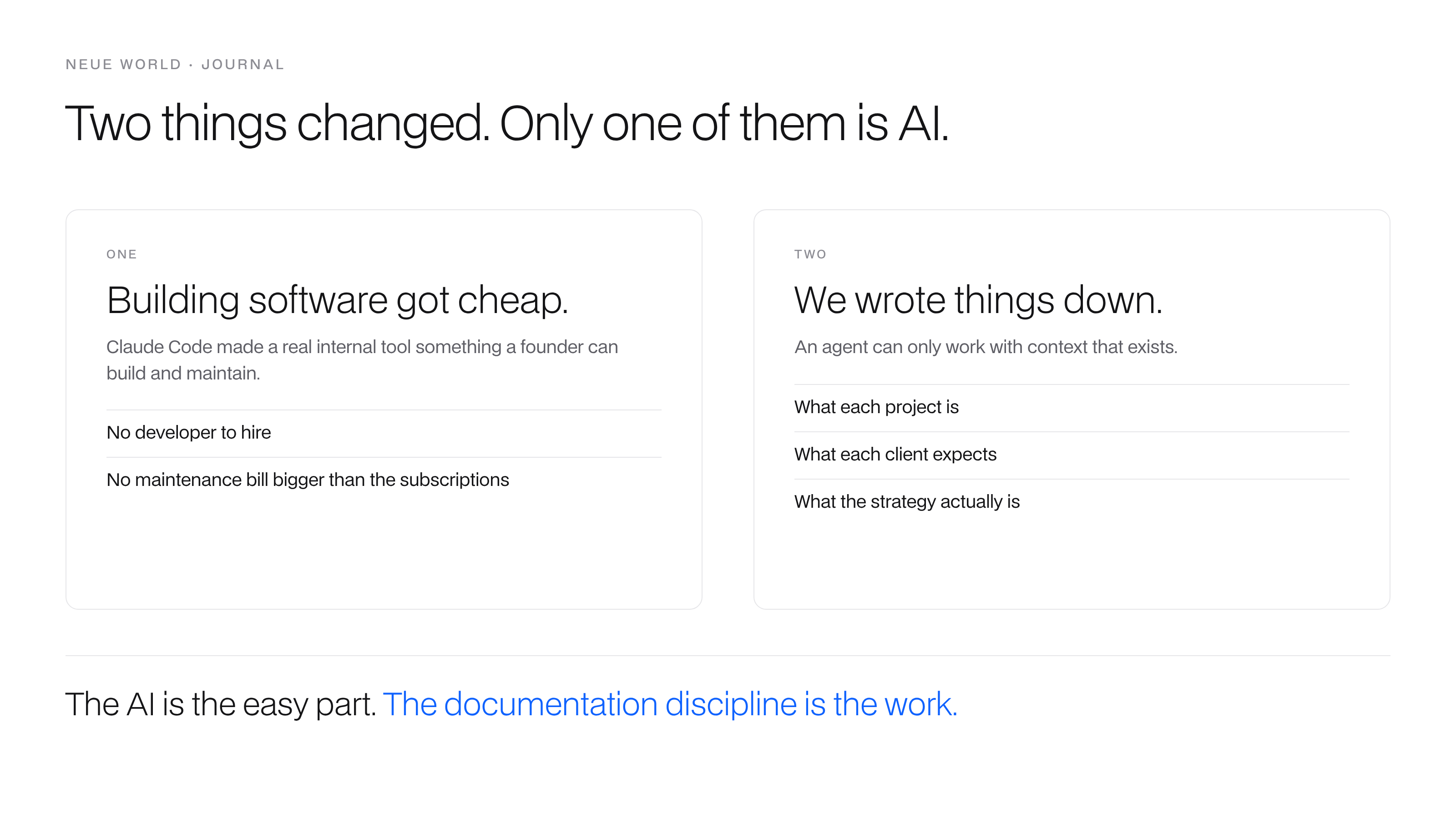
Two things, and only one of them is AI.
The first is that building software got dramatically cheaper. VIA exists because Claude Code made it realistic for a non-engineering founder to build and maintain a real internal tool. Five years ago this would have required hiring a developer and committing to ongoing maintenance costs that would have exceeded the subscriptions we were trying to avoid.
The second is documentation, and this is the part most people skip. An agent cannot work with context that doesn’t exist. Before VIA, a lot of what the agency knew lived in my head, in call notes nobody revisited, and in Slack threads. Building the tool forced us to write things down in a structured way — what each project is, what each client expects, what the strategy actually is. The agent is only as useful as that groundwork.
If you take one thing from this: the AI is the easy part. The documentation discipline is the work.
What this says about how we think about tools
We’ve been arguing for a while that the most valuable thing a design agency can deliver isn’t a file, it’s a capability. A brand book goes out of date. A set of templates runs out. A system that a client’s team can operate themselves keeps paying off long after the engagement closes.
VIA is that argument applied to ourselves. We stopped renting a workflow and built one that fits how we actually work, that knows what we know, and that improves as we do.
We’re writing more about the individual pieces — the self-updating knowledge base, the meeting pipeline, the decision to build rather than buy. Some of it is worth stealing.
Learn about VIA from this video:
